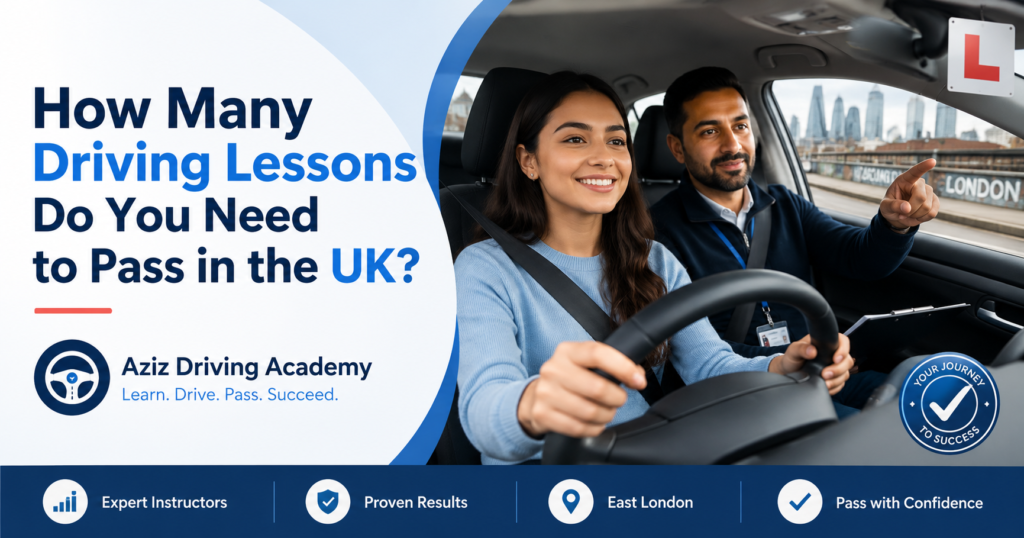
There is no minimum number of driving lessons you must complete before taking your practical driving test in Great Britain. GOV.UK states that the number of lessons you need depends on how quickly you develop the skills required to drive safely and independently. Rather than aiming for a fixed number of hours, the DVSA recommends judging your readiness by your driving ability, independence, mock-test performance and progress across the 27 core driving skills.
You will often see around 45 hours of professional tuition plus roughly 20 to 22 hours of private practice used as a planning benchmark across UK learner-driver guidance. However, this is not a legal requirement and should not be treated as a target that every learner must reach. Current official guidance focuses on competency rather than a fixed lesson count.
If you are taking driving lessons in East London, the best approach is therefore simple: track what you can do safely without help rather than counting down to a particular lesson number.
How Many Driving Lessons Do You Need on Average?
There is no single number that applies to every learner.
A complete beginner may need considerably more professional tuition than someone who already has regular supervised practice. Another learner may understand vehicle control quickly but require additional time to develop observation, planning, judgement and confidence in heavier traffic.
A useful way to think about your learning time is:
| Learner situation | What to expect |
| Complete beginner | Build every skill progressively from basic control to independent driving |
| Beginner with private practice | Professional lessons can focus on correcting technique and developing higher-level skills |
| Previous driving experience | An instructor assessment can identify which UK test-standard skills still need work |
| Nervous learner | Progress may take longer because confidence and independent decision-making need time to become consistent |
| Learner approaching a test | Lesson numbers matter less than whether you can drive safely without prompts |
The 45-hour professional tuition figure commonly quoted online should therefore be treated as a budgeting reference, not a deadline. Passing after fewer hours does not automatically make someone a better learner, and needing more hours does not mean someone is a poor driver.
Is There a Legal Minimum Number of Driving Lessons in the UK?
For learners in England, Scotland and Wales, no minimum number of professional lessons is currently required before taking the practical test.
GOV.UK specifically states that there is no minimum number of lessons or practice hours you must complete. You must pass your theory test before booking the practical test, but you do not have to provide evidence that you have completed a set number of driving lessons.
This distinction matters because many websites refer to an “average” number of hours as though it were a DVSA requirement.
It is not.
Could the Rules Change?
Possibly.
The Department for Transport ran a consultation from 7 January to 11 May 2026 on introducing a minimum learning period for learner drivers. The proposals considered options such as a minimum time spent learning, a minimum number of supervised driving hours, a logbook and a structured learning syllabus. As of the current published GOV.UK guidance, however, learners in Great Britain are still told that there is no minimum lesson requirement.
This article focuses primarily on learners in England, including East London. Northern Ireland has a separate driver licensing system and separate rules.
What Actually Determines How Many Driving Lessons You Need?
Your progress depends on more than how many hours you spend in the driver’s seat.
1. Your Previous Driving Experience
Someone starting completely from scratch first has to become comfortable with steering, braking, observation, positioning and vehicle control.
If you have already gained legal supervised practice, your instructor may be able to spend more lesson time refining judgement, manoeuvres and independent driving.
Previous experience does not automatically mean fewer lessons, however. Existing habits sometimes need correcting before they meet UK driving-test standards.
2. How Regularly You Drive
Consistency can make a major difference to your development.
Long gaps between lessons can mean spending part of the next session rebuilding confidence or revisiting skills. Regular lessons allow one session to build more naturally on the previous one.
Private practice can also add useful experience between professional lessons when it is carried out legally and safely.
DVSA guidance specifically says learners who combine professional lessons with private practice tend to perform better and become safer drivers.
3. Manual vs Automatic Driving Lessons
Manual learners need to develop clutch control, gear selection and coordination alongside the observation and decision-making skills required of every driver.
An automatic vehicle removes the need to operate the clutch and manually select gears, which some learners find makes the early stages of driving easier.
That does not mean there is an official number of lessons an automatic learner should need compared with a manual learner. Both must demonstrate safe, independent driving to the required test standard.
Aziz Driving Academy currently provides both manual and automatic tuition in East London, allowing learners to select the type of licence and training route that best suits their circumstances.
4. Confidence and Driving-Test Nerves
Knowing what to do and being able to do it consistently under pressure are different things.
A learner might perform a manoeuvre correctly during a familiar lesson but struggle when approaching an unfamiliar junction without assistance. Test readiness requires you to make safe decisions independently, including when traffic conditions change unexpectedly.
This is why confidence should be measured by consistent independent performance, not simply by feeling comfortable behind the wheel.
5. The Roads and Conditions You Experience
Driving the same quiet roads repeatedly does not provide the breadth of experience needed for independent driving.
The DVSA’s current learning framework covers 27 driving skills across areas including vehicle control, observation and planning, junctions and crossings, manoeuvres, different road types, varied driving conditions and following routes independently.
Your lessons should therefore gradually expose you to different situations rather than simply repeating a familiar test route.
The Better Question: Are You Ready to Pass?
Instead of asking only, “How many driving lessons do I need?”, ask:
“Can I consistently drive at test standard without my instructor helping me?”
That is much closer to how DVSA guidance defines readiness.
The official Ready to Pass framework tracks each of the 27 driving skills through five progress levels: introduced, helped, prompted, independent and reflection. DVSA says learners should reach Level 5 across all 27 skills before taking the test. At that stage, you should not simply perform a skill. You should understand why you used it and how it contributes to safe driving.
A learner who has completed 50 hours but still requires regular prompts may be less test-ready than someone with fewer hours who can consistently assess hazards and make safe decisions independently.
How Do You Know When You Are Test-Ready?
According to the DVSA Ready to Pass guidance, several signs matter more than your lesson total.
- You can drive without regular prompts from your instructor.
- You are not making serious or dangerous mistakes.
- You can complete realistic mock driving tests successfully.
- You have strategies for managing test nerves.
- Your instructor agrees that you are ready.
- Your driving remains safe and consistent on unfamiliar roads and in changing traffic conditions.
If one or more of these areas is still unreliable, booking additional lessons is usually more useful than focusing on the number you have already completed.
Why Mock Driving Tests Matter
A normal lesson and a practical driving test create different pressures.
During ordinary tuition, your instructor may explain situations, correct developing mistakes and help you understand what happened. During a mock test, the aim is to reproduce the independence and pressure of the real test more closely.
DVSA survey analysis previously found an average pass rate of 65% among respondents who said they had taken a mock test covering all parts of the real test, compared with 47% among those who said they had not. The figures describe the surveyed groups rather than proving that a mock test alone caused the difference, but they support using realistic mock tests as part of test preparation.
Aziz Driving Academy includes mock-test and test-day preparation as part of its East London learner support.
How Many Driving Lessons Should You Take Per Week?
There is no DVSA rule saying you must take a particular number of lessons each week.
For most learners, consistency is more important than chasing a fixed weekly total.
A regular schedule allows your instructor to build progressively from one skill to the next. If several weeks pass between lessons, some lesson time may be spent rebuilding familiarity with skills you previously developed.
Your ideal frequency will depend on your availability, budget, private-practice opportunities and how comfortably you absorb new information.
Learners working toward a specific test date may also consider an intensive course, while others may progress better with steady weekly tuition.
Can Private Practice Reduce the Number of Professional Lessons?
It can help, but private practice should complement professional tuition rather than simply add miles.
Official guidance encourages learners to gain experience across different roads, times of day and conditions. DVSA also provides a private-practice record that can be used to track experiences such as night driving, dual carriageways, different weather conditions and route planning.
Your instructor can identify a skill during a professional lesson, explain the correct technique and then suggest suitable areas to reinforce during supervised practice.
That makes private practice more purposeful.
Anyone supervising a learner must also meet the legal requirements, and learner drivers can only drive on a motorway when accompanied by an approved driving instructor in a dual-control vehicle.
Does Learning in East London Affect the Number of Lessons?
There is no official East London lesson requirement.
However, learning in a busy urban environment can expose you to situations that require strong observation, planning and judgement.
Aziz Driving Academy provides lessons across E14 and surrounding East London areas, including Docklands, Canary Wharf, Poplar, Shadwell, Whitechapel, Mile End, Bethnal Green, Stepney Green, Shoreditch, Stratford, West Ham and Newham.
For a local learner, becoming genuinely test-ready means more than memorising particular roads. You should be able to transfer what you have been taught to unfamiliar junctions, changing traffic, different road layouts and independent navigation.
That ability to apply your skills somewhere unfamiliar is a much stronger indicator of readiness than the number printed beside your lesson history.
Should You Book Your Driving Test Before You Are Ready?
Passing your theory test allows you to book a practical test, but eligibility to book and readiness to pass are not the same thing.
GOV.UK says you should only take your test when you can do everything required by the national driving standard without instruction.
If your instructor still needs to intervene regularly with the pedals, steering or verbal prompts, more preparation is likely to be valuable.
Since November 2025, the practical test has also been structured to provide greater flexibility for longer periods of independent driving and routes that can better reflect real-world conditions. That makes genuine independence particularly important.
How Aziz Driving Academy Helps You Know When You Are Ready
At Aziz Driving Academy, the goal is not to keep learners taking lessons until they reach an arbitrary hour total.
Training is built around progress.
Learners in East London can develop from fundamental vehicle control through observation, junctions, manoeuvres, independent driving and realistic test preparation. Manual, automatic, beginner and intensive options are available, alongside mock-test preparation for learners approaching their practical test.
Your instructor can assess where you are now, identify the areas that need improvement and build your lessons around those skills.
That provides a much more meaningful answer to “How many driving lessons will I need?” than applying the same number to every learner.
Frequently Asked Questions
How many driving lessons does the average person need in the UK?
There is no official minimum. Around 45 hours of professional tuition plus private practice is widely used as a planning benchmark, but current GOV.UK guidance says the number you need depends on how quickly you learn. Test readiness should be based on competence rather than a fixed number of hours.
Can I pass my driving test after 20 lessons?
It is possible if you have reached the required standard, because there is no minimum lesson requirement. However, completing 20 lessons alone does not show that you are test-ready. You should be able to drive safely and independently without instructor prompts.
Is 30 hours of driving lessons enough?
It may be enough for one learner and insufficient for another. Previous experience, private practice, lesson consistency, confidence and individual progress all influence the amount of tuition required.
Do automatic driving lessons require fewer hours?
Some learners find automatic cars quicker to become comfortable with because they do not need to manage a clutch or manual gears. However, there is no official DVSA lesson-hour requirement for either automatic or manual learners.
Can I take the driving test without professional lessons?
There is no minimum number of professional lessons required before the test in Great Britain. You must still meet the legal rules for learning and demonstrate the required driving standard during your practical test. Anyone charging to teach you must be a qualified approved driving instructor or registered trainee.
Should I take a mock test before my practical test?
A realistic mock test is a useful way to check whether you can drive independently under test-style conditions. DVSA’s Ready to Pass guidance includes being able to pass mock tests as one of the indicators that you may be ready for the real test.
How can I find out how many lessons I personally need?
Book an assessment with a qualified instructor. Your instructor can evaluate your existing skills, confidence and independence, then estimate what you still need to work on instead of assigning an arbitrary lesson total.
Start Your Driving Lessons in East London
The number of driving lessons you need to pass is personal. There is no compulsory 30, 40 or 45-hour target.
What matters is whether you can control the vehicle, read the road, recognise hazards, make safe decisions and drive independently without relying on your instructor.
If you are based in East London or E14, Aziz Driving Academy offers structured manual and automatic driving lessons for beginners, developing learners and pupils preparing for their practical test.
Book your first lesson or assessment and build a driving plan around your actual progress, not an arbitrary number of hours.