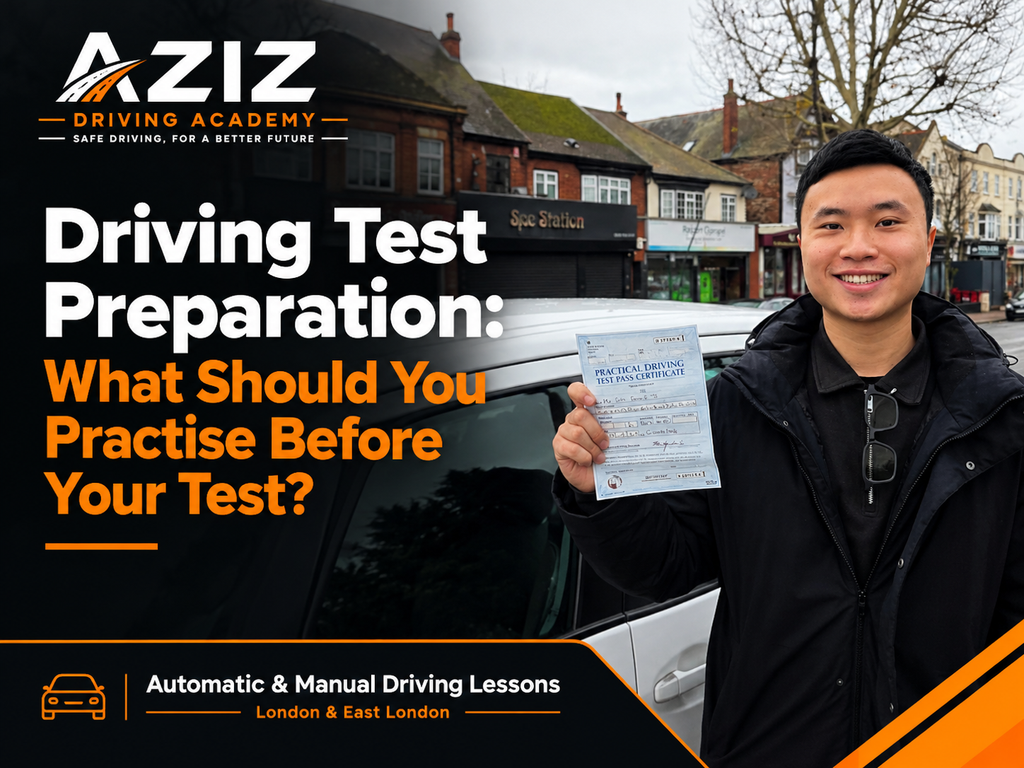
Passing your practical driving test is an important milestone. It gives you the freedom to drive independently, commute to work, visit family and friends, manage everyday responsibilities and enjoy greater flexibility.
However, preparing for a driving test is about much more than simply learning how to control a car.
You need to demonstrate that you can drive safely, make appropriate decisions, understand the road environment and respond independently to different situations.
This becomes particularly important when learning to drive in London.
London has busy roads, complex junctions, roundabouts, cyclists, pedestrians, buses, parked vehicles, one-way streets, traffic lights and constantly changing traffic conditions. Because of this, effective driving test preparation in London should prepare you for real-world driving rather than simply teaching you to memorise a test route.
At Aziz Driving Academy, we help learners develop the practical skills and confidence needed for their driving test through structured driving lessons in London and East London.
Whether you are learning automatic or manual, taking regular private lessons or considering an intensive driving course, your preparation should focus on becoming a safe and independent driver.
In this complete guide, we explain exactly what you should practise before your practical driving test, how to identify your weaknesses, how to improve your confidence and how professional driving test preparation can help you get ready.
Why Is Driving Test Preparation So Important?
A driving test can be stressful because you know that your driving is being assessed.
Some learners become nervous because they are worried about:
- Making mistakes
- Forgetting mirror checks
- Approaching junctions incorrectly
- Getting confused at roundabouts
- Performing manoeuvres
- Following directions
- Driving independently
- Dealing with busy London traffic
- Making a mistake and assuming they have automatically failed
Proper preparation can reduce uncertainty.
Instead of hoping that you are ready, structured driving test preparation allows you to identify your strengths and weaknesses before the test.
The purpose of preparation is not to make you memorise every possible test route.
Instead, you should develop skills that allow you to handle unfamiliar situations safely.
What Does Good Driving Test Preparation Involve?
Good practical driving test preparation should cover a wide range of skills.
Depending on your current ability, your lessons may focus on:
- Vehicle control
- Mirrors
- Observation
- Junctions
- Roundabouts
- Traffic lights
- Road positioning
- Appropriate speed
- Lane discipline
- Pedestrian awareness
- Cyclist awareness
- Hazard awareness
- Parking
- Reversing
- Independent driving
- Following directions
- Dual carriageways
- Dealing with unexpected situations
- Mock driving tests
The exact balance will depend on your individual needs.
A learner who is already confident with vehicle control may need more time working on independent decision-making.
A beginner may need to develop fundamental control skills first.
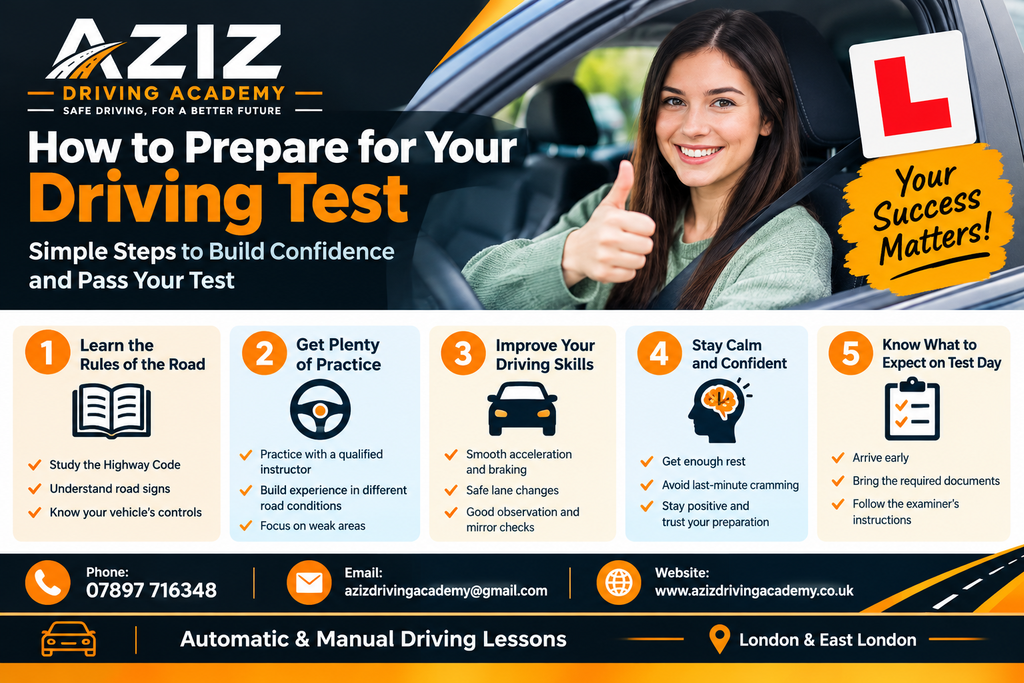
1. Practise Vehicle Control
Before worrying about complicated traffic situations, you need to be comfortable controlling your vehicle.
For manual learners, this can include:
- Clutch control
- Gear selection
- Moving away
- Stopping
- Hill starts
- Changing gears
- Low-speed control
For automatic learners, vehicle control includes:
- Smooth acceleration
- Smooth braking
- Steering
- Speed control
- Moving away
- Stopping
- Low-speed manoeuvring
The more naturally you can control your vehicle, the more attention you can give to the road.
This is particularly important in London, where you may need to observe several hazards simultaneously.
2. Practise Effective Mirror Checks
Mirror use is a fundamental part of safe driving.
However, checking mirrors is not simply about looking at them because you have been told to.
You should understand why you are checking.
Before changing speed, direction or position, you need to know what is happening around your vehicle.
For example, before moving around a parked vehicle, you may need to consider:
- Is there a vehicle behind you?
- Is a cyclist approaching?
- Is another vehicle overtaking?
- Is there enough space?
- Will your movement affect another road user?
Effective mirror use helps you make better decisions.
During driving test preparation in London, your instructor should help you develop mirror habits that become natural rather than forced.
3. Improve Your Observation
Observation is one of the most important driving skills you can develop.
You should be constantly scanning the road environment.
Look:
- Ahead
- To the sides
- In your mirrors
- At road signs
- At road markings
- For pedestrians
- For cyclists
- For vehicles emerging from side roads
You should also learn to anticipate hazards before they become immediate problems.
For example, if you see a parked vehicle with someone sitting inside, consider the possibility that a door could open.
If you see children near the road, anticipate that they may move unexpectedly.
If you see a cyclist ahead, consider whether their position might change.
This is the difference between simply seeing hazards and actually reading the road.
4. Practise Junctions
Junctions should receive significant attention during your practical driving test preparation.
You may encounter:
- T-junctions
- Crossroads
- Mini-roundabouts
- Traffic-light junctions
- Controlled junctions
- Uncontrolled junctions
- Narrow junctions
- Busy urban junctions
When approaching a junction, you need to consider:
Speed
Can you approach slowly enough to observe properly?
Position
Are you positioned appropriately?
Mirrors
Have you checked what is happening around you?
Observation
Can you see clearly?
Traffic
What other road users are approaching?
Decision
Is it safe to proceed?
Good junction driving is about planning.
Avoid waiting until the final moment to decide what you are going to do.
5. Practise Roundabouts
Roundabouts are one of the areas that many learners find challenging.
They require several skills at the same time.
You may need to consider:
- Which exit you need
- Which lane you should use
- Your approach speed
- Mirrors
- Signals
- Positioning
- Other vehicles
- Cyclists
- Traffic flow
- Your exit
A good driving instructor should help you practise different types of roundabouts rather than relying on one familiar example.
You should eventually be comfortable approaching an unfamiliar roundabout and making a safe decision.
That is far more valuable than memorising a single test route.
6. Practise Traffic-Light Junctions
London has many traffic-light-controlled junctions.
Learners should understand how to respond to changing signals while maintaining proper observation.
Do not allow traffic lights to make you stop thinking.
You still need to consider:
- Pedestrians
- Cyclists
- Vehicles
- Road markings
- Lane position
- Turning traffic
- The space ahead
If a light changes while you are approaching, make a safe decision based on the situation rather than reacting suddenly.
7. Practise Road Positioning
Correct road positioning helps you communicate your intentions and maintain control.
You should practise:
- Left-side positioning
- Lane positioning
- Turning positions
- Roundabout positioning
- Position around parked vehicles
- Position on narrow roads
- Position when changing lanes
Poor positioning can create unnecessary risk.
For example, if you are too close to parked vehicles, you may have less space to respond to an opening door or pedestrian.
If you position incorrectly at a junction, you may make it harder for other road users to understand your intentions.
8. Practise Appropriate Speed
Speed is not simply about staying below the posted speed limit.
You need to select a speed appropriate to the road and conditions.
Factors can include:
- Traffic
- Visibility
- Weather
- Pedestrians
- Cyclists
- Road layout
- Junctions
- Parked vehicles
- Road surface
- Potential hazards
A speed that feels comfortable on an empty road may not be appropriate when the road becomes busy.
During driving test preparation, your instructor can help you understand how to adjust speed according to the environment.
9. Practise Lane Changes
Changing lanes requires planning and observation.
Before changing position, you should understand:
- Why you need to change lanes
- What is around your vehicle
- Whether there is a safe gap
- Whether another road user could be affected
- Where you need to be positioned next
London’s multi-lane roads can make this particularly important.
Avoid making sudden movements because you realise too late that you need another lane.
Planning ahead gives you more options.
10. Practise Independent Driving
Independent driving is an important part of practical driving.
Your instructor should gradually reduce the amount of guidance they give you.
You may need to:
- Follow directions
- Read signs
- Select lanes
- Plan ahead
- Respond to road conditions
- Make independent decisions
The purpose is to demonstrate that you can drive without someone constantly telling you what to do.
This is also essential for life after passing your test.
Once you are licensed, you will be responsible for making these decisions yourself.
11. Practise Following Directions
During test preparation, practise following instructions without becoming distracted.
For example, if you are told to:
“Take the next available road on the left.”
You should process the instruction while continuing to drive safely.
Do not make a dangerous last-minute turn simply because you missed the road.
If you are unsure or miss a direction, continue safely.
A safe driver should never sacrifice safety simply to follow a route perfectly.
12. Practise Parking
Parking should be part of your regular driving test practice.
Depending on your training, you may practise:
- Bay parking
- Parallel parking
- Reversing
- Positioning
- Low-speed control
The most important elements are:
Control + Observation + Accuracy + Safety
Do not rush.
A slower, controlled manoeuvre is generally easier to manage than a rushed one.
13. Practise Reversing
Reversing requires careful observation.
Before and during a reversing manoeuvre, you need to remain aware of:
- Pedestrians
- Cyclists
- Vehicles
- Obstacles
- Other road users
- Your surroundings
Do not become so focused on completing the manoeuvre that you forget what is happening around the vehicle.
14. Practise Dealing With Pedestrians
Pedestrians are a major part of London’s road environment.
You should pay particular attention around:
- Crossings
- Schools
- Shops
- Bus stops
- Residential streets
- Busy high streets
- Car parks
Good observation allows you to anticipate pedestrian movement.
If someone appears likely to enter the road, you should be prepared to respond appropriately.
15. Practise Driving Around Cyclists
Cyclists are common across London.
During driving test preparation in London, you should practise how to safely deal with cyclists.
Consider:
- Their position
- Their speed
- Your following distance
- Whether they may change direction
- Whether you have enough space to pass safely
- Whether you need to wait
Never allow pressure from vehicles behind you to force you into an unsafe decision.
Patience is part of good driving.
16. Practise Busier Roads
If most of your lessons have been on quiet roads, you need to gradually experience busier environments before your test.
This can help you develop:
- Faster hazard recognition
- Better planning
- Lane discipline
- Confidence
- Patience
- Decision-making
London traffic can change quickly.
A quiet road can become congested within minutes.
Your preparation should therefore include different traffic conditions.
17. Practise Dual Carriageways
Learners should also develop confidence on faster roads where appropriate.
You need to understand:
- Speed management
- Lane discipline
- Mirror checks
- Joining traffic
- Leaving the road
- Following distance
- Overtaking considerations
- Changing lanes
The faster the traffic, the more important forward planning becomes.
You need to identify changes early rather than reacting at the last moment.
18. Practise Hazard Awareness
Hazard awareness is one of the foundations of safe driving.
A hazard can be:
- A pedestrian
- A cyclist
- A parked vehicle
- A vehicle emerging from a junction
- Roadworks
- A change in traffic flow
- A narrowing road
- A vehicle stopping unexpectedly
The important skill is recognising hazards early.
Ask yourself:
What could happen next?
That simple question can improve your ability to anticipate problems.
19. Practise Meeting Traffic on Narrow Roads
Narrow residential roads can be challenging.
You may encounter:
- Parked vehicles
- Oncoming traffic
- Pedestrians
- Cyclists
- Delivery vehicles
You need to judge whether there is enough space and decide who should proceed.
Do not rush simply because another driver is waiting.
Safe and courteous driving is more important than being first.
20. Practise Dealing With Parked Cars
Parked cars can reduce the available road space.
When approaching an obstruction, consider:
- What is behind you?
- What is ahead?
- Is there an oncoming vehicle?
- Is a pedestrian nearby?
- Is someone likely to open a car door?
- Do you have enough room?
This is another situation where effective observation and planning matter.
21. Practise Emergency and Unexpected Situations
You cannot predict every situation on the road.
You might encounter:
- A vehicle stopping unexpectedly
- A cyclist changing direction
- A pedestrian stepping toward the road
- Roadworks
- Temporary signs
- A blocked lane
- Heavy congestion
Your instructor can help you practise responding calmly.
The objective is not to predict exactly what will happen.
It is to develop the ability to recognise, assess and respond safely.
22. Take Mock Driving Tests
One of the most effective ways to prepare is to complete mock tests.
A mock driving test allows you to experience a more realistic test environment.
During a mock test, your instructor can minimise prompts and allow you to demonstrate your independent driving.
Afterwards, review:
- What went well?
- What mistakes occurred?
- Were they repeated?
- Which areas need additional practice?
- Are you consistent?
- Are you ready for the test?
One mock test should not necessarily determine whether you are ready.
Consistency is more important.
23. Identify Your Weak Areas
Every learner has different strengths and weaknesses.
You might be excellent at:
Vehicle control
but weaker at:
Independent driving.
Another learner might be confident on roads but struggle with:
Parking.
Before your test, identify your top three weaknesses.
For example:
Weakness 1
Roundabout positioning
Weakness 2
Mirror checks
Weakness 3
Independent decision-making
Then dedicate additional lesson time to those areas.
This is much more efficient than practising everything equally.
24. Don’t Just Practise Your Test Route
This is one of the most important points.
Learning a test route can provide familiarity, but it should never replace proper driving skills.
You may encounter a different route, different traffic or different circumstances.
If you only memorise:
“Turn left here, right there, second exit…”
you may struggle when something changes.
Instead, learn:
“How do I safely approach this type of junction?”
That skill can be applied anywhere.
25. Driving Test Preparation for Nervous Learners
Nervous learners may need additional preparation.
You may experience:
- Shaking
- Overthinking
- Fear of making mistakes
- Loss of concentration
- Panic during busy traffic
The answer is not to avoid challenging roads forever.
Instead, gradually build experience.
Start with situations you can manage, then progress.
For example:
Quiet road → Moderate traffic → Busy road → Complex junction → Independent driving
Repeated successful experiences can help build confidence.
26. What If You Make a Mistake During the Test?
One mistake does not necessarily mean you should give up mentally.
Learners sometimes make a small mistake and immediately think:
“I’ve failed.”
That thought can cause additional mistakes.
Instead:
- Recognise what happened.
- Stay calm.
- Continue safely.
- Focus on the next situation.
- Avoid repeating the same mistake.
Good driving requires the ability to recover calmly.
27. Automatic Driving Test Preparation
If you are learning in an automatic vehicle, your preparation should focus heavily on road awareness.
You should practise:
- Smooth acceleration
- Smooth braking
- Steering
- Mirror checks
- Junctions
- Roundabouts
- Lane changes
- Parking
- Independent driving
- Hazard awareness
Because you do not need to manage a clutch and manual gear changes, you may be able to devote more attention to the road.
However, you still need excellent observation and judgement.
Aziz Driving Academy provides automatic driving lessons in London for learners who prefer automatic vehicles.
28. Manual Driving Test Preparation
Manual learners need to combine vehicle control with road awareness.
Practise:
- Clutch control
- Gear selection
- Moving away
- Hill starts
- Gear changes
- Junctions
- Roundabouts
- Parking
- Independent driving
You should eventually be able to operate the vehicle without allowing gear selection or clutch control to distract you from the road.
29. Intensive Driving Test Preparation
If your test is approaching and you have limited time, an intensive driving course in London may be an option.
Intensive preparation can concentrate on the areas that require the most improvement.
For example:
Day 1: Vehicle control and junctions
Day 2: Roundabouts and traffic
Day 3: Independent driving
Day 4: Manoeuvres
Day 5: Mock test and weaknesses
The actual structure should be based on your ability and training needs.
Intensive lessons are not about rushing.
They are about using concentrated practice effectively.
30. Driving Test Preparation in East London
If you are learning to drive in East London, your preparation should reflect the variety of roads you may encounter.
Aziz Driving Academy provides driving lessons across areas including:
- Docklands
- Shadwell
- Whitechapel
- Canary Wharf
- Mile End
- Poplar
- Bethnal Green
- Stepney Green
- Shoreditch
- Stratford
- West Ham
- Newham
These areas provide opportunities to develop experience with different urban driving environments.
Driving Lessons in Docklands for Test Preparation
If you are looking for driving lessons in Docklands, test preparation can focus on urban traffic awareness, junctions, lane positioning and independent driving.
Driving Lessons in Shadwell for Test Preparation
Learners searching for driving lessons in Shadwell can work on observation, junctions, road positioning, traffic awareness and parking.
Driving Lessons in Whitechapel for Test Preparation
Driving lessons in Whitechapel can help learners build confidence dealing with busy urban roads and different road users.
Driving Lessons in Whitechapel
Driving Lessons in Canary Wharf for Test Preparation
If you need driving lessons in Canary Wharf, your training can include lane discipline, junctions, traffic awareness and independent driving.
Driving Lessons in Canary Wharf
Driving Lessons in Mile End for Test Preparation
Learners taking driving lessons in Mile End can practise junctions, roundabouts, residential roads, parking and independent driving.
Driving Lessons in Poplar for Test Preparation
For learners searching for driving lessons in Poplar, training can focus on vehicle control, observation, road positioning, traffic and test preparation.
Driving Lessons in Bethnal Green for Test Preparation
Driving lessons in Bethnal Green can help learners develop confidence with urban driving, junctions, observation and independent decision-making.
Driving Lessons in Bethnal Green
Driving Lessons in Stepney Green for Test Preparation
Learners searching for driving lessons in Stepney Green can work progressively on junctions, roundabouts, parking and independent driving.
Driving Lessons in Stepney Green
Driving Lessons in Shoreditch for Test Preparation
Driving lessons in Shoreditch can help learners become more comfortable with busy urban environments and interactions with pedestrians, cyclists and other vehicles.
Driving Lessons in Stratford for Test Preparation
If you need driving lessons in Stratford, preparation can include traffic lights, junctions, lane positioning, roundabouts and independent driving.
Driving Lessons in West Ham for Test Preparation
Driving lessons in West Ham can be structured around your current ability and focus on the areas you need to improve before your test.
Driving Lessons in Newham for Test Preparation
Learners looking for driving lessons in Newham can receive structured instruction focused on practical driving skills, confidence and test preparation.
How Many Lessons Do You Need Before Your Driving Test?
There is no fixed number of lessons that guarantees someone will pass.
Your requirements can depend on:
- Previous experience
- Confidence
- Lesson frequency
- Learning speed
- Vehicle type
- Road experience
- Ability to correct mistakes
- Independent driving ability
- Quality of practice
Instead of asking:
“How many lessons do I need?”
ask:
“What skills do I still need to improve?”
That gives you a much more useful answer.
How Often Should You Take Driving Lessons Before Your Test?
Consistency can be beneficial.
If your test is approaching, regular lessons can help you maintain continuity.
Depending on your circumstances, you may benefit from:
- Weekly lessons
- Multiple lessons per week
- Longer sessions
- Intensive training
The right schedule depends on your experience and availability.
The important thing is to avoid cramming everything into the final few days if you still have significant weaknesses.
How to Know If You Are Ready for Your Driving Test
You should increasingly be able to drive without constant instructor assistance.
Ask yourself:
Can I drive independently?
Can I handle unfamiliar junctions?
Can I manage roundabouts?
Do I check mirrors naturally?
Can I identify hazards early?
Can I maintain suitable speed?
Can I position correctly?
Can I complete manoeuvres safely?
Can I recover calmly from mistakes?
Can I make decisions without waiting for my instructor?
If the answer to most of these questions is yes, you may be approaching test readiness.
Your instructor can help provide an objective assessment.
Final Week Driving Test Preparation
The final week should be about consistency rather than learning everything from scratch.
Focus on:
- Your weakest areas
- Mock tests
- Independent driving
- Junctions
- Roundabouts
- Manoeuvres
- Observation
- Appropriate speed
- Road positioning
Avoid creating unnecessary pressure.
You want your driving to feel familiar and controlled.
The Day Before Your Driving Test
Try to avoid over-practising.
You should already have done the preparation.
Use the final period to remain calm and organised.
Review your main weaknesses if necessary, but do not spend hours worrying about every possible situation.
Rest and arrive prepared.
Driving Test Day: Stay Calm and Focused
On test day, remember:
You are there to demonstrate your driving—not to demonstrate perfection.
Focus on each situation individually.
If you make a mistake:
Move on.
If you miss a direction:
Continue safely.
If traffic becomes complicated:
Slow down, observe and decide.
If you feel nervous:
Take a breath and focus on the road.
Your preparation has given you the skills.
Now you need to use them.
Why Choose Aziz Driving Academy for Driving Test Preparation?
Choosing the right driving school in East London (E14) can make your learning experience more organised and productive.
At Aziz Driving Academy, driving lessons are designed around individual learner needs.
Whether you are starting from zero or approaching your practical test, lessons can focus on the skills that matter most.
Our Driving Services Include:
🚗 Automatic Driving Lessons
Learn in an automatic vehicle while developing road awareness and independent driving skills.
🚘 Manual Driving Lessons
Develop clutch, gear and vehicle-control skills alongside safe road awareness.
🎓 Private Driving Lessons
Focused lessons designed around your individual strengths and weaknesses.
👨🎓 Adult Driving Lessons
Support for adults who are starting or continuing their driving journey.
⚡ Intensive Driving Courses
Concentrated training for learners who need focused preparation.
📝 Practical Driving Test Preparation
Targeted practice covering junctions, roundabouts, manoeuvres, observation, positioning and independent driving.
Why Local Driving Experience Matters
Learning to drive in London means dealing with a wide range of road conditions.
Your preparation should therefore expose you to different environments.
A strong learner should not only be able to drive around one familiar area.
You should be able to adapt.
For example, if you learn how to approach one type of junction, you should be able to use the same principles at another junction.
If you practise one roundabout, you should understand how to approach unfamiliar roundabouts.
This is how you develop genuine driving ability.
Your Driving Test Preparation Checklist
Before your practical driving test, make sure you have practised:
Vehicle Control
☐ Moving away
☐ Stopping
☐ Steering
☐ Speed control
☐ Clutch and gears if manual
Observation
☐ Mirrors
☐ Blind spots where appropriate
☐ Forward observation
☐ Hazard awareness
Road Skills
☐ Junctions
☐ Roundabouts
☐ Traffic lights
☐ Lane changes
☐ Road positioning
☐ Appropriate speed
Manoeuvres
☐ Parking
☐ Reversing
☐ Low-speed control
☐ Observation
Independent Driving
☐ Following directions
☐ Reading road signs
☐ Choosing lanes
☐ Planning ahead
☐ Making independent decisions
Test Preparation
☐ Mock tests
☐ Weak-area practice
☐ Busy-road practice
☐ Different road environments
☐ Confidence building
Frequently Asked Questions About Driving Test Preparation
How can I prepare for my driving test?
The best preparation is regular practice covering vehicle control, observation, mirrors, junctions, roundabouts, manoeuvres, road positioning, hazard awareness and independent driving.
How many driving lessons should I take before my test?
There is no fixed number. Your instructor should assess your current ability and identify the skills you still need to develop.
What should I practise most before my driving test?
Focus particularly on your weaknesses. Common areas include junctions, roundabouts, independent driving, observation, road positioning, manoeuvres and appropriate speed.
Is driving test preparation different in London?
London presents a wide variety of traffic situations, including busy junctions, pedestrians, cyclists, buses and multi-lane roads. Your preparation should therefore include varied urban driving conditions.
Should I memorise my driving test route?
No. Understanding how to drive safely in different situations is more valuable than memorising a particular route.
Can I take an intensive driving course before my test?
Yes, an intensive driving course may be suitable for some learners, depending on their existing skills, availability and test date.
Are automatic driving lessons suitable for test preparation?
Yes. Automatic learners still need to develop strong observation, hazard awareness, road positioning, speed control and independent driving skills.
Are manual driving lessons available?
Yes. Aziz Driving Academy provides manual driving lessons as well as automatic driving lessons.
Do you provide driving lessons in East London?
Yes. Aziz Driving Academy covers multiple East London areas, including Docklands, Shadwell, Whitechapel, Canary Wharf, Mile End, Poplar, Bethnal Green, Stepney Green, Shoreditch, Stratford, West Ham and Newham.
Do you offer private driving lessons?
Yes. Lessons can be focused on the learner’s individual needs and areas requiring improvement.
Do you offer adult driving lessons?
Yes. Adult learners can start or continue their driving journey with lessons suited to their experience and goals.
Can nervous drivers take driving test preparation lessons?
Yes. Structured practice can help nervous learners gradually become more comfortable with different road situations and independent driving.
How do I know if I am ready for my practical driving test?
You should be able to demonstrate safe and consistent driving with limited prompting. Your instructor can assess your strengths and weaknesses and help determine whether additional preparation is appropriate.
Ready for Your Driving Test?
Your driving test is not simply about completing a route.
It is about demonstrating that you can drive safely, confidently and independently.
The best way to prepare is to practise a wide range of situations and understand how to respond when something unexpected happens.
If you are looking for driving test preparation in London, driving lessons in East London, automatic driving lessons, manual driving lessons, private driving lessons or an intensive driving course, Aziz Driving Academy can help you work towards your driving goals.
Don’t wait until the last few lessons to discover your weaknesses.
Start identifying and improving them early.
Your test day should be the result of the preparation you have already done.
Aziz Driving Academy – Driving Test Preparation in London & East London (E14)
🚗 Services
Automatic Driving Lessons
Manual Driving Lessons
Private Driving Lessons
Adult Driving Lessons
Intensive Driving Courses
Practical Driving Test Preparation
📍 Service Areas
Docklands • Shadwell • Whitechapel • Canary Wharf • Mile End • Poplar • Bethnal Green • Stepney Green • Shoreditch • Stratford • West Ham • Newham
📞 Contact Aziz Driving Academy
Phone: 07897 716348
Email: azizdrivingacademy@gmail.com
Website: www.azizdrivingacademy.co.uk
Ready to prepare for your driving test?
Contact Aziz Driving Academy today to discuss your driving lessons and practical test preparation.
Aziz Driving Academy — Safe Driving. For a Better Future.