Learning to drive is an exciting step towards greater independence. Whether you want to drive to work, attend university, manage family commitments or simply have more freedom to travel around London, gaining your driving licence can make everyday life considerably easier. If you are searching for driving lessons in E14, manual driving lessons in Newham, or a reliable driving instructor in East London, choosing the right instructor and learning approach is an important first step.
For new learners, driving can initially seem complicated. You need to learn how to control the car, understand road signs and markings, use mirrors correctly, anticipate hazards, deal with junctions and roundabouts, and make safe decisions around other road users.
If you are learning in a manual car, you also need to develop good clutch control, understand gear selection and coordinate the clutch, accelerator and brakes smoothly.
The good news is that you do not have to learn everything at once.
A structured driving lesson programme allows you to build your skills gradually. You can begin with basic vehicle control and progress towards more challenging traffic situations as your confidence develops.
This guide explains what new learners should know about driving lessons in E14, Newham and surrounding East London areas, how manual lessons work, what to expect from your instructor, how to prepare for the practical driving test and how to choose lessons that suit your needs.
Why Choose Driving Lessons in E14?
E14 is an important part of East London, with a mixture of residential streets, busier roads, commercial areas, junctions, parking situations and routes connecting different parts of London.
For a learner, this variety can provide valuable opportunities to develop practical road skills.
Learning in and around your local area can also help you become familiar with the types of situations you are likely to encounter during everyday driving.
A good lesson is not simply about driving around until the time runs out. Each lesson should have a purpose.
Depending on your ability, an instructor may work with you on:
- Moving off and stopping
- Clutch control
- Gear changes
- Steering
- Mirror checks
- Signalling
- Junctions
- Roundabouts
- Traffic lights
- Pedestrian crossings
- Parking
- Reversing
- Hill starts
- Lane discipline
- Independent driving
- Hazard awareness
- Dual carriageways
- Test preparation
The Highway Code advises drivers to use mirrors, check blind spots where appropriate, signal when necessary and make sure it is safe before moving off.
These habits should become natural through consistent practice.
Manual Driving Lessons in E14
If you are specifically looking for manual driving lessons in E14, your lessons will include everything required to operate a manual vehicle safely and confidently.
One of the biggest differences between learning in a manual and automatic car is the additional coordination required.
A manual learner needs to understand:
Clutch control
The clutch allows you to connect and disconnect the engine from the wheels.
At first, finding the biting point can feel difficult. With practice, you should gradually become more comfortable moving away smoothly without stalling.
Gear selection
You will learn when to select different gears according to your speed, road conditions and situation.
You should eventually be able to change gears without taking unnecessary attention away from the road.
Moving away
Moving away safely requires observation, appropriate gear selection, clutch control, accelerator control and awareness of surrounding traffic.
Stopping
You will learn how to stop smoothly and safely, including approaching junctions, traffic lights, pedestrian crossings and other situations where you need to slow down.
Hill starts
Hill starts can be challenging for new manual drivers. Your instructor can help you develop the control needed to move away safely on an incline.
Slow-speed control
Manual driving requires good control at low speeds, particularly during manoeuvres, traffic queues, parking and busy urban driving.
The aim is not simply to memorise individual actions. You should develop an understanding of how the vehicle responds so that you can make appropriate decisions in different situations.
What Happens During Your First Driving Lesson?
Many new learners feel nervous before their first lesson.
That is completely understandable.
You may have never sat in the driver’s seat before. You may be worried about stalling, making mistakes or dealing with traffic.
A professional instructor should understand that beginners need time to become comfortable.
Your first lesson may involve an introduction to the vehicle and its controls before you begin driving. Depending on your experience and the instructor’s assessment, you may then start learning basic vehicle control in a suitable environment.
Early lessons can include:
- Understanding the pedals
- Steering
- Mirrors
- Seat and driving position
- Gear lever
- Handbrake
- Clutch control
- Moving off
- Stopping
- Basic observations
You do not need to be a perfect driver on your first lesson.
Driving is a skill that develops through instruction, practice, feedback and repetition.
The important thing is to listen to your instructor, ask questions when you are unsure and focus on improving one skill at a time.
How Many Driving Lessons Do You Need?
There is no single number of driving lessons that is suitable for every learner.
Some people learn quickly because they have strong coordination or previous experience. Others need more time to become comfortable with traffic, vehicle control and decision-making.
Your required lesson time can depend on:
- Previous driving experience
- Age and learning style
- Frequency of lessons
- Confidence
- Vehicle control
- Understanding of road rules
- Amount of private practice
- Familiarity with London traffic
- Ability to identify hazards
- Progress between lessons
Instead of concentrating only on the number of lessons, it is better to focus on whether your driving skills are developing consistently.
A learner who understands why they are making a mistake can often improve more effectively than someone who simply repeats the same route without understanding the underlying skill.
Why Regular Driving Lessons Can Help
Consistency is important when learning to drive.
If you have long gaps between lessons, you may spend part of your next lesson remembering skills you previously learned.
Regular lessons can help reinforce:
- Clutch control
- Gear changes
- Mirror routines
- Road positioning
- Junction approach
- Hazard awareness
- Manoeuvres
- Independent decision-making
It can also make it easier for your instructor to track your progress.
For example, one lesson might focus on junctions. The following lesson can build on those skills by introducing more complicated junctions or busier traffic.
Gradually, the amount of instructor assistance can be reduced as your confidence improves.
Learning to Drive Safely in East London
Driving in London requires more than simply controlling a car.
You need to pay attention to many different road users, including:
- Pedestrians
- Cyclists
- Motorcyclists
- Buses
- Cars
- Delivery vehicles
- Emergency vehicles
- Parked vehicles
You may also encounter:
- Bus lanes
- Cycle lanes
- Pedestrian crossings
- Traffic lights
- Box junctions
- Narrow residential roads
- Parked vehicles
- Heavy traffic
- Complex junctions
This is why observation and anticipation are so important.
A good driver should not only react to what is happening immediately in front of the vehicle. They should continually scan the road and anticipate what might happen next.
Understanding Mirrors, Signals and Positioning
Mirror use is one of the fundamental skills assessed during a practical driving test.
The examiner assesses whether you use your mirrors effectively and at appropriate times, including when changing direction, changing speed or changing lanes.
Learners should therefore avoid treating mirror checks as a box to tick.
Instead, you should understand why you are checking.
For example, before changing position, you need to know what is around your vehicle. A mirror check can help you identify vehicles, cyclists or other road users that may affect your decision.
Your instructor can help you develop a consistent routine that becomes natural over time.
Learning Junctions in E14 and Newham
Junctions are among the most important areas for new drivers to master.
You may encounter:
- T-junctions
- Crossroads
- Y-junctions
- Staggered junctions
- Controlled junctions
- Unmarked junctions
- Busy multi-lane junctions
When approaching a junction, you need to consider:
- Your speed
- Your position
- Road signs
- Road markings
- Traffic lights
- Pedestrians
- Cyclists
- Other vehicles
- Visibility
- Priority
Official driver-training guidance emphasises safe, systematic routines for dealing with junctions and roundabouts, including observation, positioning and appropriate speed.
The objective is not to rush.
Good observation gives you time to make a safe decision.
How to Become Better at Roundabouts
Roundabouts can be intimidating for new learners, particularly when traffic is busy.
However, the principles become easier with practice.
You need to learn how to:
- Read road signs
- Understand lane markings
- Select the correct lane
- Adjust your speed
- Observe traffic
- Give appropriate signals
- Maintain safe positioning
- Change lanes safely when required
- Identify your exit
The Highway Code advises drivers approaching roundabouts to use available signs, signals and lane markings, decide which exit they need as early as possible, use appropriate signals and adjust speed and position to traffic conditions.
Your instructor can gradually introduce roundabouts according to your ability.
You might begin with simpler examples before progressing to larger and more complicated roundabouts.
Driving Lessons Near Canary Wharf
If you live, work or study around Canary Wharf, having access to driving lessons in the wider E14 area can be convenient.
The surrounding area contains a mixture of residential and commercial environments, meaning learners may need to develop strong observation, positioning and traffic-awareness skills.
For learners based around Canary Wharf, lessons can be useful for developing confidence in:
- Busy urban traffic
- Lane positioning
- Junctions
- Traffic lights
- Pedestrian activity
- Cyclist awareness
- Navigating unfamiliar roads
- Independent driving
If you are interested in lessons near Canary Wharf, contact Aziz Driving Academy to confirm current lesson coverage and availability for your specific location.
Driving Lessons Near Canning Town
Canning Town is another important area for learners looking for driving lessons in East London.
As with any busy London environment, learners should expect to encounter a mixture of traffic conditions.
Lessons can help you develop the ability to:
- Read road signs
- Identify hazards
- Maintain appropriate speed
- Use mirrors effectively
- Change lanes safely
- Deal with junctions
- Follow directions
- Drive independently
If you are searching online for driving lessons near Canning Town, it is worth asking the driving school whether your exact pickup location falls within its current operating area.
Driving Lessons Near Stratford
Stratford is a busy East London location with a mixture of residential, commercial and transport-related traffic.
For a learner driver, the important skill is learning to manage information without becoming overwhelmed.
Your instructor can help you learn to prioritise:
Observation → Decision → Action
For example, rather than reacting suddenly to a situation, you should learn to identify what is happening early, assess the available options and then take appropriate action.
This type of thinking becomes particularly important as you progress towards independent driving.
Driving Lessons Near Poplar
Poplar and the surrounding E14 area can also be convenient for learners seeking local driving lessons.
If you live nearby, local lessons may allow you to spend less time travelling to meet an instructor and more time developing practical driving skills.
Learners can use lessons to develop confidence with:
- Residential roads
- Junctions
- Parking
- Traffic lights
- Pedestrian crossings
- Busy roads
- Vehicle positioning
- Independent driving
Before booking, confirm whether your exact Poplar address is within the instructor’s current pickup area.
Driving Lessons Near Isle of Dogs
Learners living around the Isle of Dogs may also be interested in driving lessons within the wider E14 area.
The key advantage of learning in an urban environment is the opportunity to encounter a variety of everyday road situations.
Rather than learning only how to control the car, you can develop broader driving skills such as:
- Anticipation
- Hazard awareness
- Road positioning
- Lane discipline
- Speed management
- Observation
- Decision-making
- Independent navigation
These skills can remain useful long after you pass your driving test.
Driving Instructor in Aberfeldy Village
If you live around Aberfeldy Village, location can be an important consideration when choosing a driving instructor.
Aziz Driving Academy is based at:
50 Leven Rd, Aberfeldy Village, London E14 0GW, United Kingdom.
A local driving school can be convenient for learners who want lessons around their local area.
However, location should not be your only consideration.
When choosing a driving instructor, think about:
1. Communication
Can the instructor explain things clearly?
2. Patience
Do you feel comfortable asking questions when you do not understand something?
3. Lesson structure
Does each lesson have a clear learning objective?
4. Feedback
Does the instructor explain what you did well and what you need to improve?
5. Progress
Can you see your driving skills developing over time?
6. Local coverage
Does the instructor cover your home, workplace, college or preferred pickup location?
7. Manual or automatic
If you specifically want a manual licence, confirm that manual lessons are available.
Manual vs Automatic Driving Lessons
One of the biggest decisions for a new learner is whether to learn in a manual or automatic vehicle.
Manual driving lessons
A manual vehicle requires the learner to operate the clutch and gears.
Advantages can include:
- Learning full manual vehicle control
- Greater flexibility when choosing vehicles
- Developing clutch and gear-management skills
However, manual driving can require more coordination during the early stages of learning.
Automatic driving lessons
Automatic vehicles do not require the driver to manually change gears or operate a clutch.
Some learners find this simpler, particularly when dealing with heavy traffic.
The right choice depends on your circumstances, preferences and long-term plans.
If your goal is specifically to learn manual driving, make sure you choose a school offering manual driving lessons in E14 or your preferred area.
What Should You Bring to Your Driving Lesson?
For most lessons, you should arrive prepared and ready to concentrate.
Wear comfortable clothing and suitable footwear that allows you to operate the pedals safely.
It is also helpful to:
- Arrive on time
- Bring your provisional driving licence details if required
- Listen carefully
- Ask questions
- Avoid distractions
- Get enough rest
- Tell your instructor if you are nervous
- Review feedback from previous lessons
Driving requires concentration, so avoid starting a lesson when you are excessively tired or unable to focus.
How to Build Confidence as a New Driver
Confidence does not mean driving quickly or taking unnecessary risks.
Real driving confidence means understanding what you are doing and being able to make safe decisions.
A confident learner should gradually become able to:
- Anticipate hazards
- Read traffic situations
- Control the vehicle smoothly
- Choose suitable speeds
- Position correctly
- Respond calmly to unexpected situations
- Drive without constant instructor prompts
If you make a mistake during a lesson, try to understand why it happened.
For example, if you approach a junction too quickly, the important lesson is not simply “slow down next time.”
You should understand why the approach speed was inappropriate and how better observation could have given you more time.
Common Mistakes Made by New Learners
Almost every learner makes mistakes.
Some common areas include:
Stalling
Often caused by poor clutch coordination.
Forgetting mirrors
Learners can become focused on the road ahead and forget to check their surroundings.
Incorrect speed
Some learners drive too quickly for the conditions, while others drive unnecessarily slowly.
Poor positioning
Correct road positioning helps communicate your intentions and maintain safety.
Late signalling
Signals should provide useful information to other road users rather than being used after a manoeuvre has already started.
Hesitation
Some learners become overly cautious because they are unsure about traffic situations.
Poor observation
Good driving requires looking ahead, checking mirrors and identifying potential hazards.
Your instructor’s job is to identify these weaknesses and help you develop better habits.
Preparing for Your UK Practical Driving Test
Before taking your practical test, you should be able to demonstrate safe and independent driving.
The current car practical test includes an eyesight check, vehicle safety questions, general driving ability including independent driving, and a reversing exercise. The driving portion is normally around 35 minutes.
You will also be asked two vehicle safety questions, commonly known as “show me, tell me” questions. One is asked before driving and the other while driving.
The test can include:
- General road driving
- Independent driving
- Pulling over and moving away
- A hill start
- Reversing
- An emergency stop, if requested
- A parking manoeuvre
The reversing exercise can involve parallel parking, parking in a bay, or pulling up on the right, reversing and rejoining traffic.
Your instructor can help you practise these skills before test day.
What Is Independent Driving?
Independent driving is an important part of the practical test.
During the test, you may be asked to follow directions from a sat nav, traffic signs, or a combination of both. The independent-driving section normally lasts around 20 to 35 minutes.
The purpose is not to see whether you can memorise a particular route.
Instead, you need to demonstrate that you can make safe decisions while managing navigation and traffic.
If you take a wrong turn, that does not automatically mean you have failed. The examiner can give you further directions so that you can continue safely.
This is why learning to drive independently is more important than memorising test routes.
How to Prepare for Driving Test Day
As your test approaches, your lessons should become increasingly focused on independent driving and test-standard performance.
A useful preparation checklist includes:
Vehicle control
Can you control the car smoothly without unnecessary assistance?
Observation
Do you identify hazards early?
Mirrors
Are you checking mirrors at appropriate times?
Junctions
Can you approach, emerge and turn safely?
Roundabouts
Can you select the correct lane and respond appropriately to traffic?
Manoeuvres
Can you complete the required manoeuvres safely and with effective observation?
Independent driving
Can you follow signs or sat-nav instructions without constant prompting?
Safety questions
Can you answer and demonstrate basic vehicle safety tasks?
Decision-making
Can you make safe decisions without your instructor telling you what to do?
These are all useful areas to discuss with your instructor before booking your test.
Why Local Driving Experience Matters
One of the benefits of learning in your local area is exposure to real-world driving conditions.
You may encounter different traffic levels at different times of day.
A learner who only drives during quiet periods may have less experience handling busy roads.
Likewise, someone who only practises on familiar streets may find unfamiliar roads challenging after passing their test.
For this reason, good driving tuition should gradually expose learners to a range of environments.
The objective is to prepare you for driving independently—not simply for one particular road.
Driving Lessons for Nervous Learners
It is normal to feel nervous when learning to drive.
You may worry about:
- Stalling
- Making mistakes
- Other drivers
- Busy roads
- Roundabouts
- Parking
- Failing the test
The best response is not to avoid difficult situations forever.
Instead, challenging situations should be introduced gradually as your skills improve.
For example:
Stage 1: Basic vehicle control
Stage 2: Quiet roads
Stage 3: Simple junctions
Stage 4: Busier roads
Stage 5: Roundabouts
Stage 6: Complex traffic situations
Stage 7: Independent driving
Stage 8: Test preparation
This gradual approach can help learners develop confidence without being overwhelmed.
How to Get More Value from Every Driving Lesson
Your lesson does not end when the car stops.
Think about what you learned.
After each lesson, consider:
- What did I improve today?
- What mistake did I make?
- Why did I make it?
- What can I do differently next time?
- Which skill should I practise again?
- What feedback did my instructor give me?
You can also ask your instructor what you should focus on before the next lesson.
This creates a continuous learning cycle.
Learn → Practise → Receive feedback → Improve → Repeat
Over time, this can help transform individual skills into natural driving habits.
Should You Have Private Practice?
If you have access to suitable private practice with a legally permitted supervising driver and an appropriate vehicle, additional practice may help reinforce skills taught during lessons.
However, private practice should complement professional instruction rather than replace it.
If you practise something incorrectly repeatedly, you may develop habits that later need to be corrected.
Always make sure private practice follows the relevant UK legal and insurance requirements.
How to Choose a Driving School in E14
Before booking driving lessons, ask a few practical questions.
Is the school offering the type of lesson you want?
If you want manual lessons, confirm manual availability.
Does it cover your location?
Ask whether your exact postcode is within the instructor’s current pickup area.
Is the instructor experienced with beginners?
A good beginner instructor should be able to explain concepts clearly.
Can lessons be tailored to your ability?
Your lessons should not feel identical every week if your skills are developing.
Does the instructor provide feedback?
Constructive feedback is essential for improvement.
Is the booking process straightforward?
You should be able to communicate easily about lesson times and availability.
Why Choose Aziz Driving Academy?
If you are searching for driving lessons in E14, manual driving lessons in Newham or driving lessons in East London, Aziz Driving Academy can be a local option to consider.
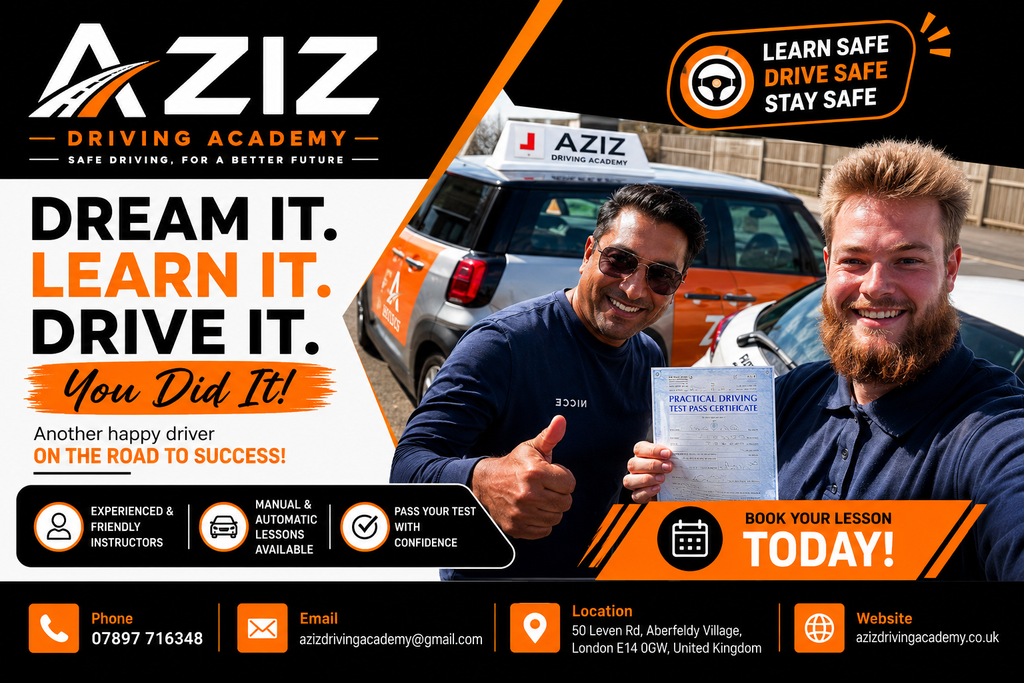
The academy is based at 50 Leven Rd, Aberfeldy Village, London E14 0GW and offers manual driving tuition for learners looking to develop their driving skills.
The focus should be on helping learners become safer, more confident and more independent behind the wheel.
Whether you are:
- A complete beginner
- Returning to driving after a break
- Preparing for your practical test
- Looking to improve specific skills
- A nervous learner
- Searching for manual lessons
- Looking for a local driving instructor
it is worth discussing your individual requirements before starting.
Coverage for areas such as Canary Wharf, Canning Town, Stratford, Poplar and Isle of Dogs should be confirmed with the academy based on your exact pickup location and current instructor availability.
Frequently Asked Questions About Driving Lessons in E14
How do I book driving lessons in E14?
You can contact Aziz Driving Academy directly by phone or email to discuss lesson availability, your experience level and your preferred pickup location.
Do you offer manual driving lessons?
Yes, Aziz Driving Academy promotes manual driving lessons. If manual tuition is your preferred option, mention this when making your enquiry.
Do you provide driving lessons in Newham?
Aziz Driving Academy serves learners in the wider E14/East London area, subject to current instructor availability and the learner’s exact location. Contact the academy to confirm coverage.
Can beginners take driving lessons?
Yes. Beginners can start with basic vehicle controls and gradually progress as their confidence and ability improve.
Can I take lessons if I have already had another instructor?
Yes. If you have previous experience, tell the instructor what you have already learned and which areas you find difficult. Lessons can then be adapted around your current level.
Can you help me prepare for my practical test?
Driving lessons can include practical test preparation, including independent driving, manoeuvres, junctions, roundabouts and vehicle safety questions.
Are driving lessons available near Canary Wharf?
If you are located around Canary Wharf, contact Aziz Driving Academy to confirm whether your specific address is currently covered.
Are lessons available near Stratford?
Coverage around Stratford should be confirmed with the academy because availability can depend on the instructor and pickup location.
Can I learn to drive around Poplar?
If you are based in Poplar, you can contact the academy to check current lesson availability for your postcode.
Are driving lessons available near Isle of Dogs?
Learners around the Isle of Dogs can contact Aziz Driving Academy to discuss their location and whether pickup is available.
Start Your Driving Journey in E14
Learning to drive is a long-term investment in your independence.
The goal should not simply be to pass a driving test. A good learning experience should help you understand the rules of the road, control your vehicle confidently, recognise hazards and make safe decisions without relying on someone else.
If you are looking for driving lessons in E14, start by choosing an instructor who understands your current ability and can provide a structured path towards independent driving.
For learners who want a manual licence, consistent practice with clutch control, gears, junctions, roundabouts, parking, observation and independent driving can help build the skills required for everyday driving.
Whether you are based in E14, Aberfeldy Village, Newham, Poplar, Canary Wharf, Canning Town, Stratford, Isle of Dogs or another nearby East London location, contact Aziz Driving Academy to discuss your requirements and confirm current availability.
📞 Book Your Driving Lesson with Aziz Driving Academy
📞 Phone: 07897 716348
Aziz Driving Academy
📍 Address:
50 Leven Rd, Aberfeldy Village,
London E14 0GW, United Kingdom
📧 Email: azizdrivingacademy@gmail.com
🌐 Website: Aziz Driving Academy
Looking for manual driving lessons in E14 or Newham? Get in touch today and start working towards becoming a safe, confident and independent driver.